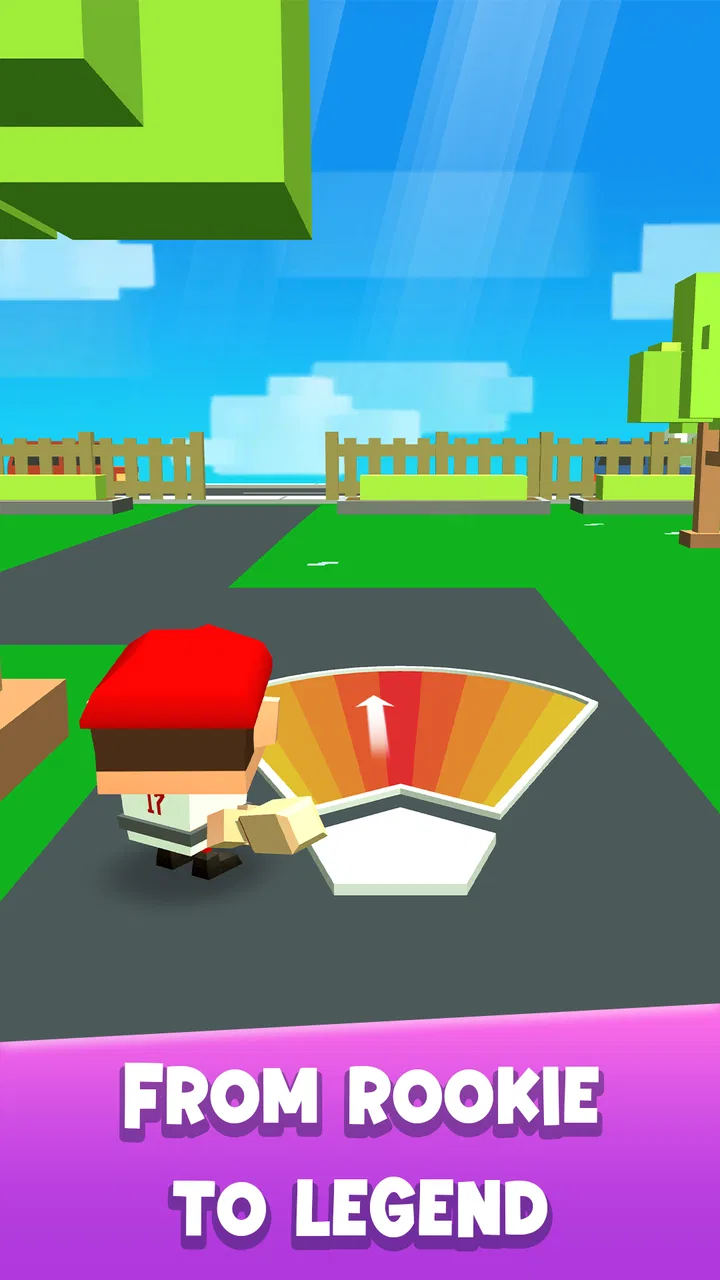
Baseball Boy!
- 3.8
- Rating
- 10.00M
- Installs
- Free
- Price

 Analysis by App-foxy
I approached Baseball Boy! as a quick arcade game rather than a full baseball simulation, and that distinction matters from the first swing. The idea is easy to understand: hit the ball, send it as far as possible, and try to improve your next attempt. It is the kind of game I can open for a short break without learning a complicated control scheme, but its simplicity also puts pressure on the progression. When the core action is repeated often, small frustrations become much more noticeable.
Developed by VOODOO, this free game is aimed at players who enjoy brief, repeatable challenges. It is available for Android devices running version 8.0 or later, carries an Everyone age rating, and has reached over ten million installs. Those figures suggest that its straightforward arcade format has found a broad audience, although popularity alone does not tell me whether it will suit your patience or spending habits.
What the swing feels like in everyday play
The best way to understand the appeal is to imagine a familiar situation: I have a few minutes before an appointment, I do not want to commit to a long match, and I want something that gives me an immediate result. Baseball Boy! fits that moment well. A single attempt has a clear purpose, and the outcome arrives quickly enough that I can play one round or continue for longer without planning a session.
You May Also Like

 Blood Strike: 2.5 Anniversary
Blood Strike’s Loadouts Turn Every Drop Into a Tactical Gamble
A close look at Blood Strike’s custom loadouts: how fast access to signature weapons reshapes its battle royale rhythm, rewards preparation, and narrows the gap between fights.

 Pandora - Music & Podcasts
Pandora’s Music Is Easy to Start, but Harder to Recover
Pandora’s strength is its low-effort path from a seed to a station. Its weak spot is how much confidence it asks you to place in connection, setup, and quiet recovery.

 8 Ball Pool
 Is Built on Rivalries, Rematches, and Routine
A close look at the rivalries, rematches, shared routines, and unanswered safety questions that turn a quick pool match into a persistent mobile community.

 Samsung Music
’s Quiet Strength Is Playing What You Already Own
Its reach comes less from spectacle than from dependable access to a personal library. That simplicity is both the app’s strongest retention engine and its ceiling.

 AccuWeather: Weather Radar
AccuWeather Review: A Quick, Clear Forecast for Everyday Decisions
For everyday plans, the best forecast is the one you can understand quickly. AccuWeather makes rain timing, radar, and local conditions easy to act on, with a few trade-offs.

 Hill Climb Racing
Why Hill Climb Racing Still Turns Crashes Into One More Run
A tiny car, a bumpy hill and one more upgrade: Hill Climb Racing keeps resurfacing because its simple chaos makes every near-miss feel personal.
More From Our News Desk



That short-session design is its strongest quality. I do not need to remember a complicated story, manage a team, or study a large menu before playing. The baseball theme gives the action a recognizable shape, while the arcade structure keeps the focus on the next hit. It is closer to a repeatable timing-and-distance challenge than to traditional baseball, so anyone expecting pitching, fielding, innings, or a detailed career mode should adjust expectations before downloading it.
I also found that the game’s simplicity creates a useful rhythm. A hit gives me an immediate result, the result encourages another attempt, and the next attempt provides a small personal target. That loop works particularly well when I want a distraction that does not demand full concentration for a long period. It is less suitable when I am looking for variety, strategic team decisions, or a deep sports experience.
Why the arcade format works
Baseball Boy! understands that a single satisfying action can carry a casual game. The baseball is the entire point, so the experience is not diluted by unnecessary systems. For younger players and people who prefer uncomplicated controls, that directness is inviting. The Everyone rating also makes it a reasonable family-friendly option in terms of its listed age category, although adults should still decide whether the repetitive loop is appropriate for the particular player.
My main caution is that the first impression can be stronger than the long-term variety. The basic action is immediately readable, but repeated swings can begin to feel similar if the player needs a constant stream of new mechanics. This is not a flaw for a short-break game; it becomes a limitation when someone treats it as a primary game for extended sessions.
A practical approach is to use it in small bursts. I would play a few attempts, stop when the loop starts to feel automatic, and return later instead of forcing a long session. That habit makes the simple design feel intentional rather than shallow. It also reduces the temptation to spend merely to keep a repetitive session moving.
Progress creates both motivation and pressure
The appeal of distance-based arcade play is that every attempt feels measurable. Even without turning the experience into a full sports simulation, the player naturally compares one hit with the next. That creates a personal challenge: can I improve my timing, make a cleaner attempt, or push beyond my previous result?
That same structure can produce pressure. When progress is built around repeating the same central action, a disappointing result can feel like lost momentum. I sometimes found myself wanting to try again immediately, not because the game had introduced a new situation, but because I wanted to correct the previous attempt. This is a normal arcade tension, yet it is worth recognizing if you are sensitive to loops that encourage “one more try” behavior.
My most useful tip is to separate improvement from luck in your own mind. Instead of judging every swing only by its distance, I would pay attention to whether the attempt felt controlled. That makes the game less frustrating and gives each restart a clearer purpose. It also prevents a single poor result from turning into an unnecessarily long session.
Another sensible habit is to decide on a stopping point before playing. For example, I might open the game while waiting for transportation and stop after the wait is over, regardless of whether the last attempt was good. That simple boundary matters because arcade progression can make a free game feel more demanding than expected, especially when the next improvement appears close enough to chase.
Spending: what the purchase range tells me
Baseball Boy! is free to download, with in-app purchases listed from $0.99 to $8.99 per item. That is the important purchase context for anyone deciding whether to try it. The game can be entered without an upfront payment, while optional items may create a route for spending during play.
I would not treat the presence of purchases as proof that spending is required, and I would not promise that paying improves the experience in every case. The responsible conclusion is narrower: the game has optional paid items, so players who want a strictly no-spend experience should review the purchase prompts carefully and use the device’s purchasing controls where appropriate.
The range also changes how I evaluate the game’s value. A free arcade title can be worthwhile when I enjoy the basic loop on its own. If I only enjoy it after considering a purchase, then the free entry point is less convincing for me. My recommendation is to play long enough to decide whether the unmodified core action is enjoyable before considering any optional item. Do not buy simply because a poor attempt feels frustrating.
For families, this is especially practical. Since the game is listed for Everyone but includes individual purchases priced from less than a dollar to several dollars, I would check the phone’s purchase authentication and make sure the player understands that “free” refers to downloading, not necessarily to every possible item inside the game. That is not a criticism of this specific title; it is the sensible way to handle any free mobile game with paid options.
Fairness and the competitive question
The fairness question is slightly different here from the one I would ask about a multiplayer sports game. Baseball Boy! is primarily about beating my own previous result, so the most obvious competition is personal rather than a direct contest against another person. That reduces some concerns about spending creating an advantage over a live opponent.
Still, spending can affect how a player experiences progress, even in a solo arcade game. If paid items make advancement feel smoother, a player who spends may have a different path from someone who refuses to pay. I would therefore judge fairness by a simple standard: can I enjoy the central swing-and-improve loop without treating purchases as the expected solution to every setback?
My answer is cautiously positive for casual use, with an important qualification. The game works best when I treat the score as a personal challenge and the purchases as optional extras rather than as part of the definition of success. It is not the right choice for someone who wants a carefully balanced competitive environment where every player has identical resources and progression conditions.
Compared with a traditional baseball game, the trade-off is clear. A simulation offers more control, more baseball-specific decisions, and usually a stronger sense of sporting competition. Baseball Boy! offers faster access and less commitment. Compared with other minimalist arcade games, its baseball framing gives the repeated action a distinct identity, but it does not remove the basic limitation of the genre: the core loop has to remain enjoyable after the novelty fades.
Who should try it, and who should skip it
I would recommend it to someone who wants a lightweight arcade game for short pauses, likes chasing personal improvements, and does not need a complete baseball ruleset. It is also a reasonable pick for players who prefer a game that can be understood quickly rather than one that begins with tutorials, rosters, or a long campaign.
I would be more hesitant to recommend it to a baseball fan seeking authentic sport. If your ideal experience involves choosing pitches, reading a defense, managing a lineup, or playing a complete match, this is not a substitute. The same applies to players who lose interest when a game repeats one action for a long time. In that case, a more varied arcade title or a deeper sports game would probably be a better use of your storage and attention.
I would also skip it if your main goal is a transparent, no-purchase environment. The game is free, but the listed in-app purchase range means that spending is part of the overall product context. You may still enjoy it without paying, but anyone who wants no prompts or no purchase decisions at all should choose a game designed around a single upfront payment or a clearly purchase-free model.
Questions I would ask before installing
Is it a full baseball game? No. I see it as an arcade interpretation built around hitting and distance, not as a replacement for a baseball simulation. That is a strength when I want immediacy and a weakness when I want tactical depth.
Can I play it casually? Yes, that is where it makes the most sense. Its short, repeatable attempts suit waiting rooms, commutes, and brief breaks. I would avoid judging it by the standards of a long-form console or mobile sports game.
Do I have to pay to start? No. The game is free to download. However, in-app purchases range from $0.99 to $8.99 per item, so I would treat the free download and the optional spending layer as separate decisions.
Is it appropriate for children? Its listed content rating is Everyone, which makes it broadly accessible by age category. For a child using a shared device, I would still secure purchase approval because the game includes paid items.
Will it run on my phone? Android users need version 8.0 or later. The current version is 2.0.6, so I would check the device’s operating system before trying to install it, especially on an older handset.
My trust verdict after weighing the trade-offs
The public response is sizeable, with an average rating of 3.8 from around 222 thousand ratings and roughly 57 thousand written reviews. I read that as a sign of broad interest rather than a guarantee of universal satisfaction. The score fits my own balanced impression: the game has a clear, accessible idea, but the same simplicity that makes it convenient can limit its staying power.
VOODOO has made a focused arcade game rather than an expansive baseball experience. I appreciate that focus when I want a quick hit-and-try-again session. I am less convinced when I want long-term variety, deep competition, or a purchase-free environment. The free entry point makes trying it easy, and the Everyone rating keeps its audience broad, but the optional spending range means I would approach it with sensible boundaries.
My final recommendation is to try it as a short-session arcade game, not as a complete baseball title. Play the basic loop first, decide whether personal improvement is enough to keep you interested, and only then consider whether any paid item is worthwhile. If that core action feels satisfying without extra spending, Baseball Boy! can be a handy little time-filler. If you need strategic baseball, constant variety, or perfectly uniform competitive conditions, I would choose a different game instead.
FAQs for Baseball Boy!
01What is the main objective of Baseball Boy! and how do you play it?
Baseball Boy! is a casual arcade game where the primary objective is to hit a baseball as far as possible. Players control a character who swings a bat, and the goal is to achieve maximum distance with each hit. As you progress, you can upgrade your stats, like strength and speed, to hit the ball even further.
02Are there in-app purchases in Baseball Boy! and are they necessary?
Yes, Baseball Boy! offers in-app purchases. These purchases can enhance gameplay by allowing players to buy upgrades more quickly. However, they are not necessary to enjoy the game. Players can still progress and unlock upgrades by playing regularly and accumulating in-game currency.
03What platforms is Baseball Boy! available on and is it free to download?
Baseball Boy! is available on both Android and iOS platforms. The game is free to download and play, but it includes advertisements. Users have the option to remove ads through in-app purchases if they prefer an uninterrupted gaming experience.
04How does the upgrade system work in Baseball Boy!?
In Baseball Boy!, the upgrade system is crucial for advancing in the game. Players earn coins each time they hit the ball, which can be used to upgrade various stats such as strength, speed, and bounce. These upgrades help in hitting the ball further, allowing players to achieve higher scores and unlock new levels.
05Does Baseball Boy! require an internet connection to play?
No, Baseball Boy! does not require a constant internet connection, making it perfect for offline play. However, an internet connection might be needed for certain features like watching ads for bonuses or making in-app purchases. Playing offline will also disable in-game advertisements.
Pros
- Simple
- intuitive controls for easy gameplay.
- Bright
- colorful graphics enhance user experience.
- Offers a variety of upgrades to keep players engaged.
- Quick sessions make it ideal for short breaks.
- Offline play available
- no internet required.
Cons
- Repetitive gameplay may become monotonous.
- In-app purchases can be costly for upgrades.
- Limited variety of environments to explore.
- Ads can be intrusive and frequent.
- Lacks depth in strategy and skill development.

Baseball Boy!
Gallery